 UA
 RU
 EN
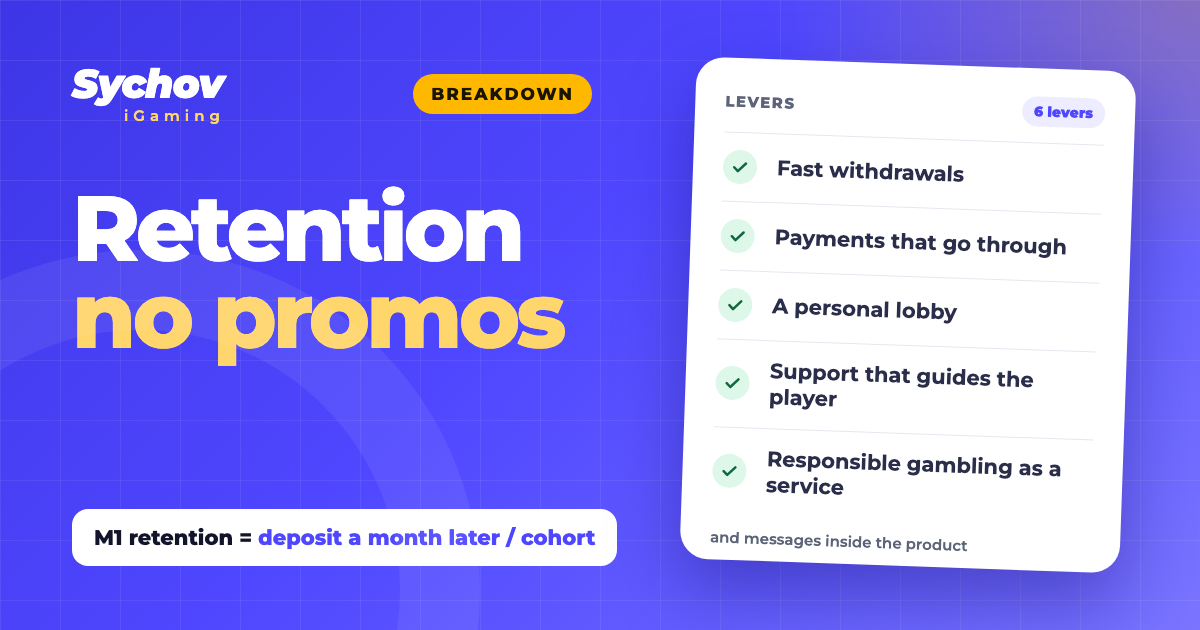
Retention is the share of players who are still active after a set period, for example a month after their first deposit. Regulators are restricting the tools CRM has relied on to retain players: mailings, bonuses and VIP. What remains is the product, payout speed, the cashier and service. Below you will find the formula with an example, five regulatory decisions from a single month, six levers without promos and what to measure.
What retention is and how to calculate it
One formula, a cohort and an honest definition of activity.
A cohort is a group of players who made their first deposit in the same period. M1 is the first month after it, M2 the second, and so on. We count a player as active if they made a deposit or a real-money bet: a login without money says nothing about revenue.
| Month after first deposit | Deposited | Retention |
|---|---|---|
| M1 | 340 | 34% |
| M2 | 250 | 25% |
| M3 | 200 | 20% |
| M4 | 170 | 17% |
| M5 | 150 | 15% |
| M6 | 130 | 13% |
An illustrative example on a cohort of 1,000 players. Take your own figures from cohorts by first deposit month.
The curve almost always falls most steeply in the first two months and then reaches a plateau. The plateau is the players who stay for the long term. The job of retention is to lift the early part of the curve and keep the plateau higher.
Days or months
D1, D7 and D30 show how the product welcomes a newcomer: whether the player came back the next day, a week later or a month later. This is a metric for product and onboarding. Monthly retention M1-M6 is about money: it is the basis for the LTV forecast and for deciding how much you can pay to acquire a player.
What counts as good retention
Retention that grows from cohort to cohort. Market figures depend on geo, product and traffic source, so they are only good for analysis. Compare your own cohorts: month on month, by source, by segment and by first payment method.
Monthly retention lags behind. A player who deposited every Friday and missed a Friday is still active in the monthly report, but this is already the earliest signal of churn: a broken rhythm.
Where the rules are heading: five decisions in one month
They all point the same way: fewer promos and mailings, more obligations to look after the player.
A House of Lords committee called for a ban on gambling advertising as soon as possible, a full ban on direct marketing in place of consent, and a ban on wagering requirements. The government's response is expected by mid-November
A temporary government measure banned online betting and casinos along with their advertising. Sites have been switched off since 06.10, banks returned player balances until 14.10, and licences end on 25.10. Congress still has to approve the measure, and lawsuits against it await a Supreme Court ruling
All online operators must offer a deposit limit that counts all money deposited, with no deduction for withdrawals. Only this kind of limit may be called a deposit limit
Licensees will have to monitor player behaviour continuously and step in when there are signs of problems. This duty and the advertising restrictions would apply from 01.07.2027 if the law is passed
A bill by an independent Northern Territory MP was introduced on 14.10: a ban on bonus bets and VIP schemes and deposit limits for players aged 18-24. The second reading cannot come before November
Based on reports from regulators, parliaments and trade media: House of Lords, Brazil, deposit limits, Denmark, Australia. This is not legal advice: check the requirements with the lawyer for your licence.
Six levers without promos
Each one works without bonus money and without marketing consent.
A player who gets their money in hours rather than days comes back. A slow withdrawal that can be reversed while pending looks like retention, but in reality it is a reason to leave
Every decline in the cashier is a player who wanted to pay and could not. Track the approval rate by bank and method, offer another method right after a decline, send a message after an abandoned deposit. An extra 10 points of approval rate means an extra 100 players for every 1,000 deposit attempts
The player's favourite games and providers first, new releases from them, and only games available in their country. The lobby works on every visit. Where personalisation is restricted, start simple: recent and favourite games
It solves the issue the first time, points out new releases and tournaments, and helps with the cashier and limits. How to turn support into a source of revenue is covered in the breakdown on support
Restrictions hit mailings first of all: email, SMS and push. Players see on-site messages, banners by segment and their account page when they come in on their own. Check in advance how your licence treats them
Limits, time reminders and breaks that are easy to find and set up. A player who feels in control stays longer. And monitoring behaviour is becoming a duty, as in the Danish bill
Where bonuses are allowed, they do not disappear, they become more precise: fewer mass offers, more calculation for each player. How to keep their cost within your margin is covered in the Bonus Rate breakdown.
If a market closes: a step-by-step plan
In Brazil, 11 days passed from the decision to the sites being switched off.
Stop all promos, bonuses and marketing mailings to the market. Close registration and deposits if the decision requires it
One clear message to all players in the market: what is happening, until what date and how to withdraw their money. This is a service message, not marketing
Faster withdrawals and a separate queue in support. No delays and no option to reverse a pending withdrawal: the player's balance is their money
Decide and announce in advance what happens to bonus money and unfinished wagering. Silence here turns into complaints and disputes
Refunds of balances to players who did not withdraw in time, under the market rules: in Brazil this went through the banks. Data export and storage as the licence requires, and a final message
The same order works when you leave a market by your own decision: players remember how you said goodbye.
What to measure instead of opens and clicks
With fewer mailings, the CRM report is built around money and service.
M1-M6 by first deposit month, separately by source and segment
The share of new players who came back with money. The second deposit is the earliest sign of whether a player is staying
The median from request to money in the player's hands, by method. When the time grows, churn grows
How many players wanted to pay and could not
How many players missed their usual deposit day or interval
Any retention work is measured against a control group, for example 10% of players left untouched. Without it, growth cannot be told apart from seasonality
One screen a week is enough: six figures, compared with last week and with the control group. If a figure drops, the report shows at once where: in the cashier, in withdrawals or in the product.
Frequently asked questions
What is retention in simple terms?
It is the share of players who keep playing for real money after a set period. For example, out of 1,000 new players, 340 make a deposit a month later: retention is 34%.
How do you calculate retention?
Take a cohort by first deposit month and calculate what share of it made a deposit in each following month: M1, M2 and onwards. Count activity by money, not by logins.
What counts as good retention?
Retention that grows from cohort to cohort. Market figures depend on geo, product and traffic, so compare your own cohorts with each other: by month, source and segment.
How is retention different from CRM?
Retention is the result: how many players stay. CRM is one of the tools: segments, messages and offers. The product, the cashier and support work for retention too.
Can you retain players without bonuses?
Yes. A bonus speeds up the decision, but players stay because of the product: favourite games, fast payouts, payments that go through and service.
The bottom line: regulators are taking the loudest tools away from CRM, but not retention itself. Retention work moves into the product, the cashier and service, and it should be measured by cohorts and money, not by email opens.
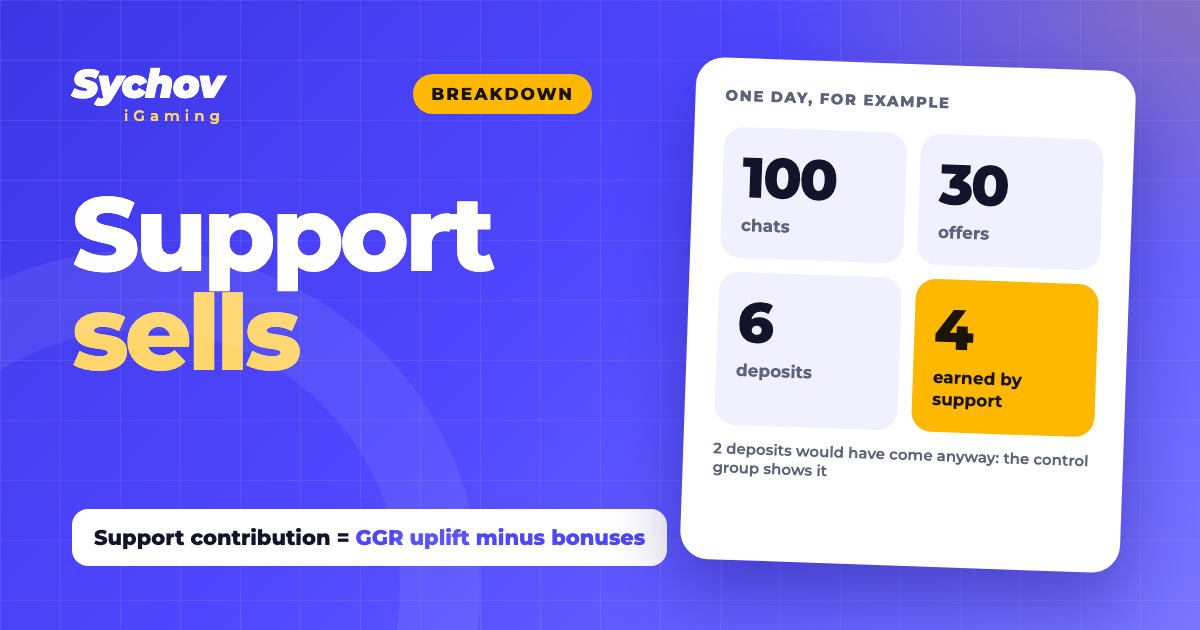 Next breakdownSupport that sells: how it earns and where to reinvestHow casino support sells bonuses and leads players into tournaments and promos, how to measure its contribution honestly, and how to fund a sales team with it in 3 to 6 months.Read