UA
 RU
 EN
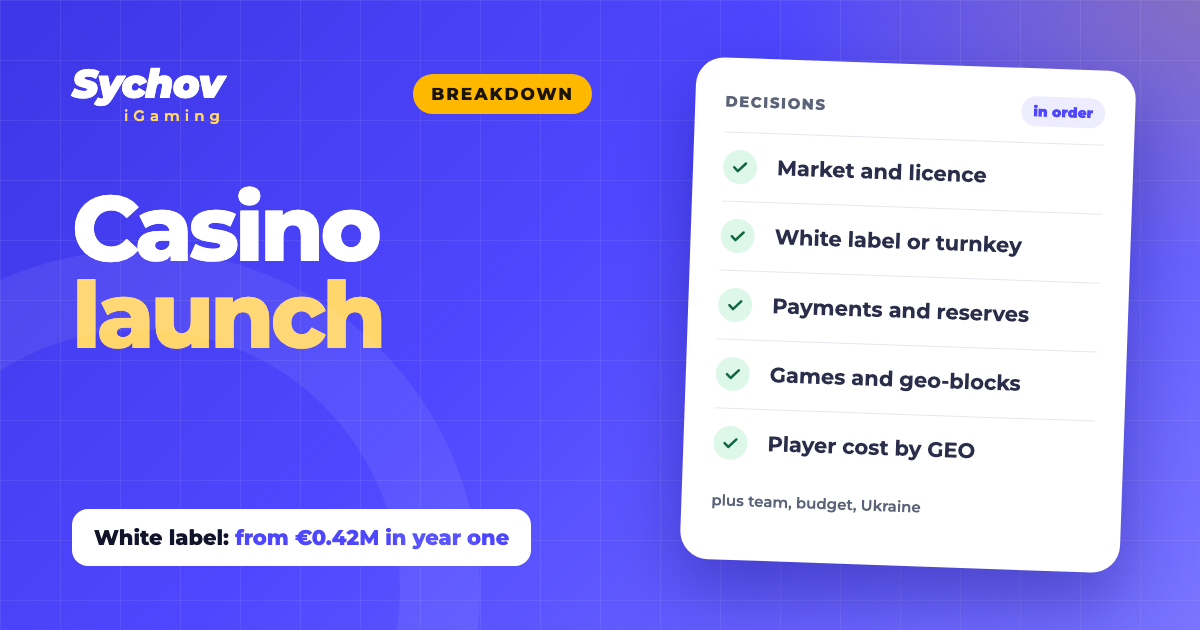
Launching an online casino in 2026 comes down to six decisions in order: market and licence, platform model, payments, games, player acquisition and team. The first decision shapes the rest: the licence decides which payments, ad channels and games you can use. A first-year budget starts at roughly €0.4M on a white label and reaches €4-5M on your own platform. Below are 2026 numbers with dates and sources, a separate section on Ukraine and the mistakes that cost money.
What changed in 2026
Markets close within a month, taxes rise, and ads run only with a licence for each country.
Provisional Measure 1.394 banned online betting and casino together with advertising and payments. Sites went offline on 06.10 and authorisations end after 30 days. More on the Brazil GEO page
The UK raised online casino duty from 21% to 40% from 01.04, the Netherlands to 37.8% from 01.01, Mexico to 50% from 01.01. Malta takes 15% on revenue from Malta-based players from 01.10
Gambling ad certification is now separate for each country, requires a licence for that country and its number in the site footer. Affiliates may send traffic only to operators licensed in that country
The CGA licensing portal was exposed to outsiders from December 2025 to September 2026 and was shut on 07.10. Licences remain valid, but licensee owners' documents may have leaked
Alberta opened on 13.07.2026. New Zealand sold licence rights at NZ$15M each, operations from 2027. Finland opens on 01.07.2027
The takeaway: you can no longer choose GEOs by player cost alone. A market can close within 30 days, like Brazil, and India and Japan already treat promoting online casinos as a criminal offence.
Market and licence: what it costs and what it gives
Pick the market first, then the licence for it, and only then the platform.
There are two paths. A local licence in a regulated market gives legal access to that country's players, advertising and banks, but costs more and needs a local company, servers and taxes. An offshore licence is cheaper and faster, but it does not let you operate where a country requires its own licence, and it narrows your choice of banks and providers. Below are official regulator fees as of October 2026, excluding intermediaries, a local company and lawyers.
| Licence | Application | Yearly | Worth knowing |
|---|---|---|---|
| Ukraine, online casino (PlayCity) | free | UAH 33.7M | UAH 56.2M for 5 years in equal parts, the yearly part tripled until the state online monitoring system goes live. Plus UAH 30M capital and a UAH 62.3M guarantee |
| Curacao, B2C (CGA) | €4,592 | €47,450 | A perpetual licence under the LOK law. There is no official list of prohibited countries: the operator must follow each country's law |
| Anjouan | €17,828 to issue | €17,828 | Review takes about 6 weeks. The Central Bank of the Comoros said on 08.12.2025 that it does not recognise these licences |
| Malta (MGA) | €5,000 | €25,000 + a GGR-based contribution | More widely accepted by banks and providers than offshore licences; the 15% tax applies only to Malta-based players |
| Kahnawake (KGC) | $35,000 | $20,000 | The application fee rises to $40,000 from 01.01.2027 |
Sources: Ukrainian Law 768-IX and the PlayCity licensing portal (10.2026), the CGA fee document (re-posted 12.10.2026), the Anjouan regulator fee page (01.04.2026), MGA, KGC.
What a licence does not give you: access to banks and PSPs, contracts with game providers, or the right to take players from countries with their own regulation. Acquirers check the licence separately, and many studios restrict games by country and by licence.
White label, turnkey or your own platform
The cheapest way in becomes the most expensive way to grow.
| White label | Turnkey | Own platform | |
|---|---|---|---|
| What you get | The provider's platform, often with its licence, payments and games | Platform and integrations; the licence, payments and team are yours | Your own code: PAM, wallet, bonuses, back office |
| Setup | €10-60k | €25-100k+ | from €100-800k |
| Monthly | €3-15k or a minimum | €5-25k | support €100-300k a year |
| Provider share | 10-30% of GGR | 5-15% of GGR or a fixed fee | 0% |
| Launch | 2-12 weeks | 3-6 months | 12-18 months |
| Best for | A first launch, testing a market | A team with its own licence and traffic | A group with technology and volume |
Add 25-35% to any turnkey quote for integrations, custom work and third-party subscriptions. In a white label offer check the share base (GGR or NGR), the monthly minimum, the provider's reserve, what the price excludes (studios, payments, KYC) and exit terms: a €15k minimum on a 12% share at €30k GGR effectively becomes 50%.
Platforms on the market in 2026
No platform publishes a full rate card in 2026: prices are quoted per market, licence and volume. The table shows models and markets from public data as of October 2026. It is neither an advertisement nor a recommendation.
| Platform | Models | Licences and markets | Pricing |
|---|---|---|---|
| EveryMatrix | Turnkey, modules | UKGC, MGA, US states, Ontario, about 19 jurisdictions | On request |
| Soft2Bet | White label, turnkey | MGA, Sweden, Denmark, Romania, Italy, Greece, Spain, Ontario | On request |
| Digitain | Sportsbook and casino | UKGC, MGA, Isle of Man, Romania, Serbia | On request |
| BetConstruct | White label, turnkey, sportsbook | Group entities with UKGC and MGA | On request |
| GR8 Tech | White label, turnkey, sportsbook | MGA, Peru | On request |
| SoftGamings | White label, turnkey, aggregator | MGA, Curacao, Belgium, Isle of Man | Published range: €15-60k setup, €3-15k a month, 10-50% of GGR (12.2025) |
| NuxGame | White label, turnkey, aggregator | Romania (B2B), Curacao and Anjouan (B2B) | On request |
| Upgaming | Turnkey | Options with MGA and Curacao | On request |
| Altenar | Sportsbook: white label, turnkey | MGA, UKGC, Ontario | On request |
| White Hat Gaming | White label for regulated markets | UKGC | On request |
Licence and model data from public profiles and industry reviews as of 16.10.2026. Before signing, check the platform's licences in the regulators' registers.
Payments: fees, reserves and approval
The cashier decides how many players can pay at all.
| Method | Deposit fee | Reserve | Settlement |
|---|---|---|---|
| Cards, MCC 7995 | 2.5-7% | 5-10% for 90-180 days | in 2-7 days |
| Open banking | 0-2.5% | usually none | instant or next day |
| E-wallets | 1-2.5% | per contract | per contract |
| Bank transfer | 0.5-1.5% | none | in 1-3 days |
| Crypto | 0.2-1% | usually none | often instant |
Counting fixed fees, reserves and chargebacks, cards cost 8-11% of deposits in 2026. A 10% rolling reserve held for 180 days on $100k of monthly card volume keeps about $60k frozen at all times. From 01.04.2026 Visa treats a dispute ratio from 1.5% as excessive in the US, Canada, the EU and Asia. Recoding gambling payments under another MCC ends in termination and a 5-year blacklist.
Onboarding through a PSP takes 1-4 weeks, directly with a bank 4-8 weeks. The acquirer asks for a licence held by the same entity, incorporation documents, 6-12 months of bank statements, a volume forecast, AML and KYC policies, and reviews the site. Several providers and cascading lift the approval rate: card declines in iGaming average 10-20%.
Games: aggregator or direct deals
Content costs a share of GGR, and game availability depends on country and licence.
- Studios take 10-20% of GGR for slots via mid-tier providers or an aggregator. Live casino costs more: up to 20-25% of GGR for live-heavy operators.
- A full-service aggregator adds 5-15 percentage points on top of studio terms; a technical routing aggregator charges 1-3%.
- Direct integration takes 6-10 weeks of engineering per provider and costs tens of thousands of euros a year per jurisdiction for testing and certification.
- Geo-blocks. Many studios restrict games by country and by licence, so the lobby is built around the GEO list, not only the provider fee.
What a player costs by GEO
Marketing, not technology, is the biggest line in year one.
CPA below is the affiliate payout per qualified casino first deposit, using 2026 data. All figures come from commercial sources and none are audited, so use ranges, not single numbers. Sources define GEO tiers slightly differently.
| GEO | Casino CPA | Median first deposit | Examples |
|---|---|---|---|
| Tier-1 | $150-400, median $250 | $85-140 | UK, Germany, the Nordics, regulated US and Canada |
| Tier-2 | $80-200, median $120 | $30-60 | Spain, Italy, Portugal, Poland, Czechia, Chile |
| Latin America | $50-200 | n/a | Mexico, Colombia, Peru. Brazil closed since 25.09.2026 |
| Southeast Asia | $50-150 | $5-20 | Thailand, Vietnam, the Philippines |
| Africa, South Asia | $15-90 | $5-20 | Nigeria, Kenya |
Sources: Track360 (18.07.2026), GAFFG (08.09.2026), Basher Agency (30.09.2026), Scaleo (19.10.2026). There is no fresh CPA data for Ukraine.
Casino revenue share averages 30% of NGR (usually 25-35%), and 35-50% for offshore operators. About 45% of new Tier-1 deals are hybrid: $75-150 CPA plus 15-25% of NGR. The real player cost is the CPA times the share of affiliate deposits you accept: $300 at a 50% approval is $150 per raw deposit. A registration costs €35-80 in Tier-1 and €4-18 in Tier-3.
Channels and their rules in 2026
- Google Ads: certification per country since 26.08.2026, with a licence for that country and its number in the footer.
- Meta: only with written permission and a licence for the target country; 19 countries stay closed even with permission.
- Telegram Ads: gambling advertising is fully banned, with no exception for licensed operators.
- Affiliates remain the main channel; from 01.01.2027 Australia bans activity-based commissions for affiliates.
- SEO: noticeable organic growth for a new site takes 6-12 months, 12-24 months for competitive terms.
Retention from day one pays back the player: 32-41% of players in Tier-1 and 19-28% in Tier-3 make a second deposit by day 7. Price your bonuses before launch with the bonus cost calculator and keep the Bonus Rate as a share of GGR.
Team: who you need and what it costs
A white label needs 5-8 people, a turnkey 10-15.
On a white label the provider runs the technology, the licence and often payments. You need a project lead, CRM and retention, an affiliate manager, a media buyer, content and SEO, a payments and fraud analyst, support (outsourced or 2-4 people) and an outsourced AML officer. A turnkey with your own licence adds in-house compliance, a payments manager, a BI analyst, a product owner, QA and 24/7 support. Your own platform also needs an engineering team for 12-18 months before launch.
| Role | Ukraine, remote (per month) | Malta, mid-level (per year) |
|---|---|---|
| Marketing, CRM | $2,000-4,700 | €36-48k |
| Compliance | $2,700-5,300 | €40-52k, MLRO €50-60k |
| Engineering | $3,200-6,000 | €40-55k |
| Support | $1,300-3,300 | €28-35k |
Ukraine: guide figures from the DOU forum (05.07.2026), not a survey. Malta: a recruiter salary guide (02.2026).
KYC is cheap next to CPA: from $0.33 for a full check bundle to $1.89 plus $0.64 for PEP and sanctions screening, depending on the service. For 5,000 checks a year that is $1.7-12.7k.
First-year budget: three scenarios
This is a guide built from the ranges above, not a quote: vendors price your exact market.
| Scenario | Fixed part for 12 months | What it includes |
|---|---|---|
| White label under the provider's licence | €0.42-1.45M | Setup and minimums, legal, payments and KYC, player reserve, site, €60-440k marketing, a 5-8 person team |
| Turnkey with your own offshore licence | €1.05-3.9M | Licence and preparation, platform, game integrations, payments and reserves, compliance, €0.3-1M marketing, a 10-15 person team |
| Own platform | €1.5-5M+ | 12-18 months of development plus nearly every turnkey line, usually with no revenue in year one |
On top come variable costs that grow with GGR: the platform share of 10-30% above the minimum, studios 10-20%, payments 2-5% of GGR, bonuses 10-20% of GGR and market taxes. In a regulated market add the local licence, capital and guarantee: in Ukraine that is about UAH 126M of cash in year one, of which only the licence fee is an expense.
If you launch in Ukraine
A legal market with an expensive licence, strict advertising rules and payments only through Ukrainian banks.
- Licence. The regulator is PlayCity. A 5-year online casino licence costs UAH 56.2M, with the yearly part tripled to UAH 33.7M while the online monitoring system runs in test mode. A betting licence costs UAH 259.4M, online poker UAH 43.2M. Applications can be filed via Diia, with a decision in 15 working days.
- Requirements. A resident legal entity only, at least UAH 30M of capital in cash, a UAH 62.3M payout guarantee, a .UA domain, servers in Ukraine, players aged 21+, and payments only through accounts at Ukrainian banks.
- Taxes. 18% of gaming income minus player payouts, plus a separate 18% profit tax. From player winnings the operator withholds 18% tax and a 5% levy.
- Advertising is allowed only in a closed list of places under Law 4116-IX: TV and radio from 23:00 to 06:00, 21+ publications and online media, your own sites and pages, and platforms with 21+ targeting. The fine is 600 minimum wages, UAH 5.19M.
According to PlayCity, 21 online casino and 5 betting licences were active on 01.01.2026, and studies by Kantar, Gradus and Factum cited in the government strategy put the illegal segment at 39-53%. For the market, players, payments and calendar see the Ukraine GEO page.
Where money is lost at launch
- Choosing the platform before the market. Then the provider's licence turns out not to fit the GEOs, banks and ad channels you need.
- Comparing only the percentage. The monthly minimum, the provider reserve and what the price excludes can multiply the real share.
- Budgeting marketing for three months. A player pays back over months, while PSP and payout reserves freeze cash you cannot spend.
- Buying traffic in closed GEOs and channels. Ads without a local licence, Telegram Ads, India, Japan and Brazil end in account bans and fines.
- Switching CRM on after launch. Without a second-deposit flow and a bonus policy, half of the players you paid for never come back.
Frequently asked questions
How much does it cost to start an online casino?
By our estimate the fixed part of year one is €0.42-1.45M for a white label under the provider's licence, €1.05-3.9M for a turnkey with your own offshore licence and from €1.5M for your own platform. Marketing is the biggest line in every scenario.
Can you open an online casino without a licence?
No. Without a licence there are no banks, game providers or ad channels, and in regulated countries it is a criminal or administrative offence. A white label runs under the provider's licence, but that licence also works only where it is recognised.
What is a white label casino?
It is your brand launched on a provider's ready platform, often with its licence, payments and games. Entry is cheap and fast, 2-12 weeks, but the provider takes 10-30% of GGR.
How is turnkey different from white label?
On a turnkey the licence, payments and team are yours, and the provider supplies the platform for a fixed fee or 5-15% of GGR. It costs more at the start and pays off from about €116-144k GGR a month.
How long does a launch take?
A white label takes 2-12 weeks, a turnkey 3-6 months including licence and integrations, and your own platform 12-18 months of development. An Anjouan licence takes about 6 weeks to review; a Ukrainian licence decision takes 15 working days.
Which casino licence is the cheapest?
By official fees the cheapest popular option is Anjouan: €17,828 to issue and the same each year. But the Central Bank of the Comoros does not recognise it, and such licences get fewer banks and providers than Curacao or Malta.
The bottom line: in 2026 a launch starts with the market and the licence, because they decide access to banks, advertising and games. Choose the platform for your volume, and budget a full year ahead, reserves and marketing included.
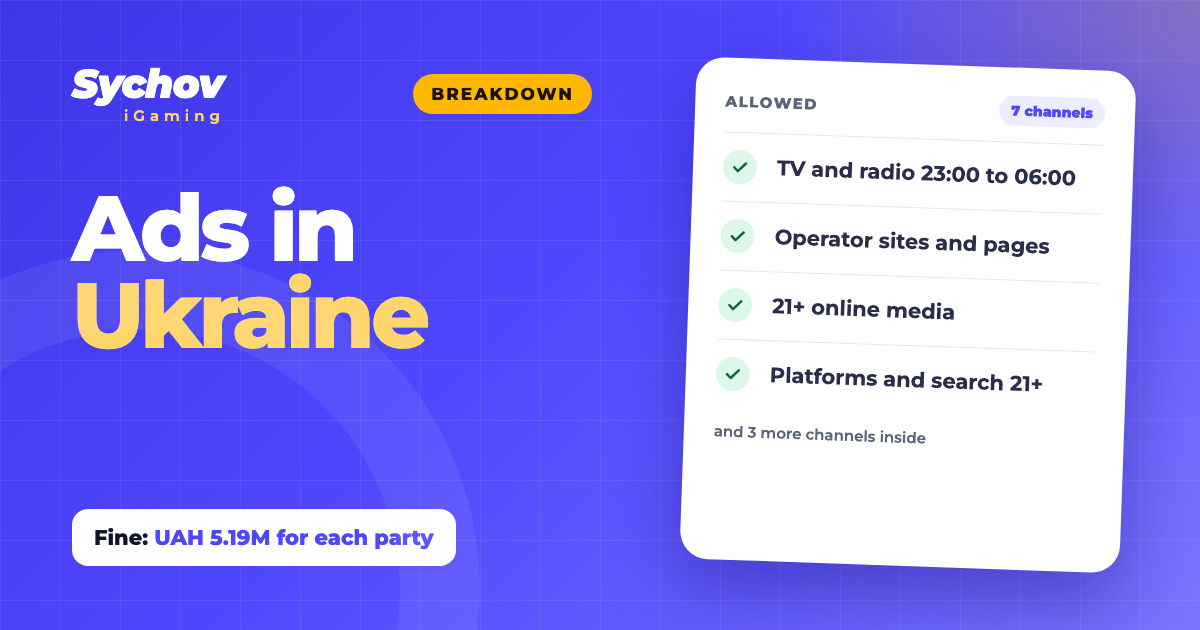 Next breakdownGambling advertising in Ukraine 2026: what Law 4116-IX allowsWhere casinos and betting may advertise in Ukraine: 7 permitted channels, influencer bans, the mandatory warning, sponsorship and a UAH 5.19M fine for every party.Read