 UA
 RU
 EN
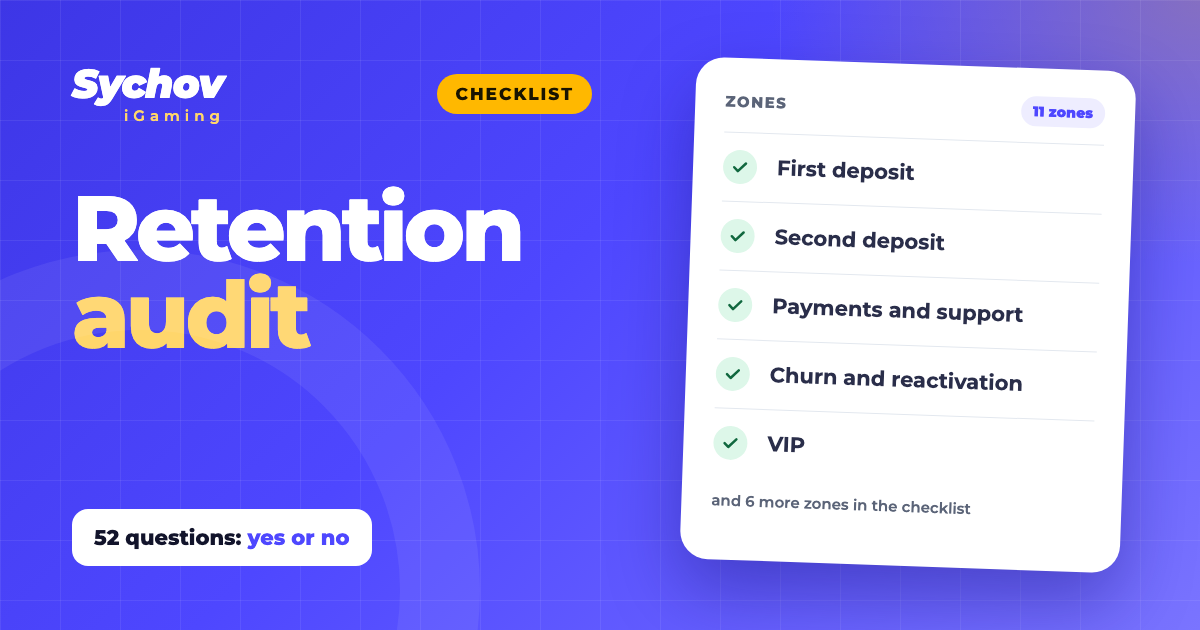
A retention audit is 52 questions across 11 zones of the player journey, from registration to VIP. Go through it with your team in 15 minutes: answer each question yes or no, then count the no answers per zone. The zone with the most is where your casino loses players.
Teams usually look for churn where it has already happened. But players leave earlier: at a decline in the cashier, at a stuck first withdrawal, between the first and second deposit. The questions below cover each of these steps.
- Bring CRM, product, payments, support and VIP together.
- Answer honestly: yes or no. If you do not know the answer, it is a no.
- Count the no answers per zone. Where there are the most, that is where players leave.
Answer buttons sit next to each question, with a counter under each zone and the score at the bottom of the screen. Your answers are saved only in this browser and are not sent anywhere.
Registration and first deposit
The first hours after registration decide whether a player ever reaches the cashier.
- 1. Do you know your first deposit conversion at 24 hours, 7 days and 30 days for each traffic source?A single overall figure hides poor sources. Look at each one separately.
- 2. Does a player with no deposit get their first message within the first few hours after registration?A reminder, help with payment and an offer on day one, not a week later.
- 3. Is an abandoned deposit caught by a trigger?The player started paying and did not finish: a message within half an hour, different for each decline reason.
- 4. Is the welcome bonus shown at its maximum, with all the terms visible before the deposit?The banner shows the "up to" amount, the terms show the deposit, wagering requirement and time limits. A dispute with a player starts with the small print.
- 5. Does the first withdrawal go through without a verification that takes days?Ask for documents in advance and in the player's language. A stuck first withdrawal often turns into the last visit.
Answered no in this zone: 0 of 5
Further reading: FTD, abandoned deposit, welcome bonus, KYC.
Second deposit
The second deposit is the earliest sign of whether a player will stay.
- 6. Do you track conversion from the first deposit to the second separately?This is the key step in retention: players who make a second deposit stay noticeably more often.
- 7. Is there a scenario between the first and second deposit, rather than silence?A reason to come back in the first 2-3 days: their game, a tournament, free spins on their favourite slot.
- 8. Does your second offer ask for no more than the first one?At this step you are building a habit, not a bigger deposit. Grow the average deposit only with active players.
- 9. Does the player see their progress right after the first deposit?A level, a mission or cashback that is already building up: something to come back for.
Answered no in this zone: 0 of 4
Further reading: the skill that finds why FTDs skip the second deposit, second deposit rate, onboarding.
Active players
Players who pay on their own need a reason to play, not an extra bonus.
- 10. With active players who deposit on their own, do you avoid handing out personal bonuses without a reason?For them: tournaments, missions, cashback and new releases. A personal bonus for someone who pays anyway is pure cost.
- 11. Do your offers take into account the player's favourite game, provider and bet level?Free spins in a game the player does not launch will not work. And check that the game is available in their country.
- 12. Do you notice money sitting unplayed on a balance?What is needed here is a reason to play, not a bonus: a new release, a tournament, a mission.
Answered no in this zone: 0 of 3
Further reading: active player, cashback, player segmentation.
Product and personalisation
The site retains players on every visit when it is tailored to them.
- 13. Are site banners different for different segments?A newcomer with no deposit, an active player, a churned player and a VIP each see their own. A welcome bonus on a VIP's home page is wasted space.
- 14. Is the game lobby personal rather than the same for everyone?AI builds selections from the player's history: games similar to their favourites, new releases from their providers, recent games first.
- 15. Does game search find what the player meant straight away?AI search understands themes, mechanics, providers and typos: "fruits", "bonus buy", a misspelt title. An empty results page often ends the session.
- 16. Is localisation built for each geo, not just a translation?Copy by native speakers, local currency and payment methods, games popular in the country, round bonus amounts in the local currency, support in the player's language.
- 17. Are sportsbook offers matched to the player's favourite sport?The sport, league and team, an offer for the next match. A football free bet will not work for a tennis fan. No sportsbook: skip this question.
Answered no in this zone: 0 of 5
Further reading: personalisation, retention without bonuses and mailings.
Payments and support
This is where you lose players who already wanted to pay.
- 18. Do you know your deposit approval rate by method, bank and country?Every decline in the cashier is a player who wanted to pay. An average approval rate hides the bank or country where fewer than half of payments go through.
- 19. Does a repeat deposit take one or two clicks?A saved method and an amount based on past deposits. Every extra step in the cashier cuts off a share of repeat deposits.
- 20. Do withdrawals arrive in hours rather than days?The median withdrawal time by method in the weekly report. A withdrawal held back in the hope that the player reverses it brings a little GGR now and loses the player later.
- 21. Does support resolve the issue on first contact?The agent sees the player's deposits, bonuses and withdrawals and can credit compensation themselves. A player who has had to explain the problem three times leaves.
Answered no in this zone: 0 of 4
Further reading: approval rate, cashier, withdrawal, reverse withdrawal, support that sells.
Gamification
A reason to come back without bonus money.
- 22. Do players have gamification: levels, missions, tournaments, a wheel?It is a reason to come back without a personal bonus. If only bonuses keep players, retention costs more.
- 23. Do you know which player motivation each mechanic appeals to?Progress in levels, collecting in achievements, competition in tournaments, surprise in the wheel. Newcomers need progress, active players need competition, VIPs need status.
- 24. Do players have a reason to log in every day?A daily reward, a mission of the day, a wheel, a tournament of the day. A streak the player would hate to break brings them back on its own.
Answered no in this zone: 0 of 3
Further reading: gamification, tournament, loyalty programme.
Churn and reactivation
The sooner you notice a player leaving, the cheaper it is to win them back.
- 25. Do you have your own churn definition for each segment, rather than 30 days for everyone?For a player who deposits every day, a week of silence is already churn. Count activity by money, not by logins.
- 26. Do you know what happened to a player before they left?The latest events: a declined payment, a slow or rejected withdrawal, an unresolved complaint, an expired bonus. The reason for leaving points to the right offer better than the segment does.
- 27. Do you ask less of a player the deeper they are in churn?Win them back on their previous terms and with a smaller deposit: you do not know what has happened to their finances in the meantime.
- 28. For reactivation, do you pick the best offer and games for each player?The offer type based on their history: free spins, cashback or a deposit bonus. Games from their providers and new releases that came out while they were away.
- 29. Do you catch a broken rhythm straight away?A player deposited every Friday and missed a Friday: an offer the same day, not a month later.
- 30. Do you give inactive players time to claim an offer?At least 72 hours to activate: someone who has not logged in for a long time will not see the offer within a day.
- 31. If emails get opened but not clicked, do you change your approach?A different channel, a different game, a different format. Repeating the same mailing teaches players to ignore it.
- 32. Are self-excluded players and players with limits or risk signs removed from every mailing?A check before every send, including triggers and reactivation. A player who has set a limit or a break themselves is not churn for CRM.
Answered no in this zone: 0 of 8
Further reading: churn, reactivation, dormant player, self-exclusion, responsible gambling.
VIP
When one high roller leaves, it shows in revenue straight away.
- 33. Do you spot future VIPs before they become VIPs?The size of the first deposits, the bet and how often they play are visible as early as the first week.
- 34. Does the manager see a drop in VIP activity on the same day?A broken rhythm, bets below the usual level, withdrawals with no new deposits. A VIP rarely says they are leaving: they simply start playing somewhere else.
- 35. Does the VIP manager decide when and through which channel, while staying within common rules?Freedom in the approach, but the offer maths is the same for everyone. Otherwise the cost of the VIP programme gets out of control.
- 36. Do bonuses for high rollers have a hard cap on winnings?A high roller's real-money bets count towards wagering too, so a low wager with no cap gets expensive.
- 37. Do you check the source of funds of high rollers in advance?Documents before a large withdrawal, and the full list at once. A stuck large withdrawal sends a VIP to a competitor.
- 38. Do VIP players get a reply from support faster than everyone else?A separate line or priority in the queue. A slow reply to a high roller costs more than any bonus.
Answered no in this zone: 0 of 6
Further reading: VIP programme, high roller, source of funds, max cashout.
Bonuses and their cost
A bonus retains players only if its cost was calculated up front.
- 39. Do you calculate Bonus Rate against GGR rather than deposits?Bonus cost for a period divided by GGR for the same period. Against deposits, the figure looks softer than it really is.
- 40. Do you calculate bonus cost with player behaviour factored in?Most players do not finish wagering, while those who do take large sums. The "bonus minus margin" formula is off several times over.
- 41. Does every bonus state a minimum and a maximum deposit?Without a maximum, a bonus on a large deposit costs more than you planned.
- 42. Is there a minimum and a maximum bet for wagering?The maximum keeps the bonus cost in check, the minimum cuts off hours of play with tiny bets just to clear wagering.
- 43. Does the time allowed for wagering depend on the wager?The higher the wager, the more time: at least 72 hours for x40, at least 48 for x30, 24 hours for x20 and below.
- 44. Can a player deposit without a bonus and cancel an active bonus?A forced wager blocks the withdrawal of real money, and the very first dispute becomes the last visit.
- 45. Can players see their wagering progress in real time?How much has been bet, how much is left and by what deadline. Without this, the player does not understand why they cannot withdraw their money.
Answered no in this zone: 0 of 7
Further reading: the Bonus Rate breakdown, bonus cost calculator, wagering requirement, max bet rule, bonus expiry.
Communications
Every unnecessary message uses up the player's attention.
- 46. Does each player have a shared weekly message limit across all channels?Email, push, SMS and messengers combined. Without a limit, unsubscribes grow, not deposits.
- 47. Are the games in emails tailored to each player?The games block is built from their favourite providers, recent games and similar new releases. One selection for the whole base gets fewer clicks.
- 48. Do you measure campaign effect against a control group?The GGR uplift among recipients minus bonus cost. Without a control group, any bonus looks like a success.
Answered no in this zone: 0 of 3
Further reading: contact policy, trigger campaign, control group.
Analytics and player economics
Decisions are made on cohorts and medians, not on averages.
- 49. Do you review retention by cohort every week?By registration week and source, not as total revenue: it hides the fact that new players leave faster.
- 50. Do you check averages against the median and by segment?A few high rollers pull the average deposit and LTV up. The median and segments show what is happening with the majority.
- 51. Are your dashboards built for decisions rather than for the sake of a report?A funnel from registration to VIP, with an owner and an action threshold for every metric. Churn and active players are counted the same way across all teams.
- 52. Do you calculate the cost of a player from the 1st to the 5th deposit, including CPA and RevShare?The affiliate payout and bonuses on each deposit against the player's GGR. You can see at which deposit a player pays off and which source is profitable.
Answered no in this zone: 0 of 4
Further reading: cohort retention, LTV, CPA, RevShare, player payback period.
How to read the score
The more no answers you have, the more stages at which players leave.
The score on the scale appears once you have answered every question. You can skip the sportsbook question.
Where you answered no most often
| Answered no | What it means |
|---|---|
| 0-9 | Retention is in place. Next comes fine-tuning in the zones where you answered no. |
| 10-21 | Noticeable losses in one or two zones. Start with the one where you answered no most often. |
| 22 or more | Players leave at several stages. Start with the first and second deposit: mistakes there cost the most. |
What to do next
An audit only pays off if changes follow.
- Take the zone with the most no answers and close two or three questions a month, not all of them at once.
- Before any new bonus, calculate its cost in the bonus cost calculator.
- If you answered no in the zones on bonuses and mailings, read the breakdown on retention without bonuses and mailings.
- Repeat the audit once a quarter and compare the number of no answers by zone.
Frequently asked questions
What is a retention audit?
A check of the whole player journey, from registration and the first deposit to VIP. The goal is to find the stages where the casino loses players before churn shows up in the reports.
How do you run a retention audit at a casino?
Get the heads of CRM, product, payments, support and VIP together and go through the 52 questions, answering only yes or no. If nobody knows the answer, it is a no. Then count the no answers in each of the 11 zones and start work on the zone with the most.
How long does the audit take?
The answers themselves take about 15 minutes if you do not debate every point. Fixes take longer: two or three questions from the weakest zone a month and a repeat audit once a quarter.
Who should take part in the audit?
The heads of CRM, product, payments, support and VIP, plus an analyst with the data. On their own, each of them sees only their part of the player journey, and players often leave where these parts meet: between the cashier, support and CRM.
Which zone should you start with?
The one with the most no answers. If several zones are level, start with the first and second deposit: mistakes there cost the most because the player is not yet used to the product.
The bottom line: players do not leave in the churn report, they leave earlier, at specific steps. The checklist shows these steps in 15 minutes, and the work should start with the weakest zone.
The PDF version of the checklist is pinned in the Telegram channel: print it out and go through the audit with your team.
 Next skillsecond deposit: why FTDs skip the second deposit, a Claude skillA free Claude Code skill: 12 reasons why FTDs skip the second deposit, the missed Sum Dep per month and a list of fresh FTDs for CRM, built from your exports.Open the skill